(written on February 15th, 17th, and 18th from notes taken previously).
I got a late start this morning (not leaving my little sleeping spot until almost 11:15 😅)nand badly needed to get back into town to get gas, so Tākaka was my first stop.
Once I had cell signal again, I went online to see what updates there might be with the pilot whales from yesterday. Unfortunately, I learned that they had all re-stranded, including one or two additional whales.
What was worse was that, of the 16 or 17 whales that re-stranded (most of them now for the third day), one or two of them had died.
😞
So once again we had 15 whales that needed to be rescued. 🛟
There was no way I was going to do anything else today other than go right back up there to help again, so as soon as I got gas, I fired off a message to Nick (the Dane I met last night) to let him know about the opportunity again today, and then I headed right back on up the coast toward Farewell Spit.
I arrived a little earlier in the day today than yesterday (about 1:15 yesterday and 12:30 today). Gratefully, the whales were re-stranded a lot closer to the car park than yesterday, so there was much less of a walk to get out to them today.
High tide was also a little bit later in the day today (it gets later by about 50 minutes each day, of you didn’t already know that), so I was there both a little bit earlier, and everything was going to happen a little bit later.
That meant that this time, instead of arriving just in time to help carry the whales out, there was a little more preparation being done (and a little more training for me, as I hadn’t yet been part of pre-refloating efforts).
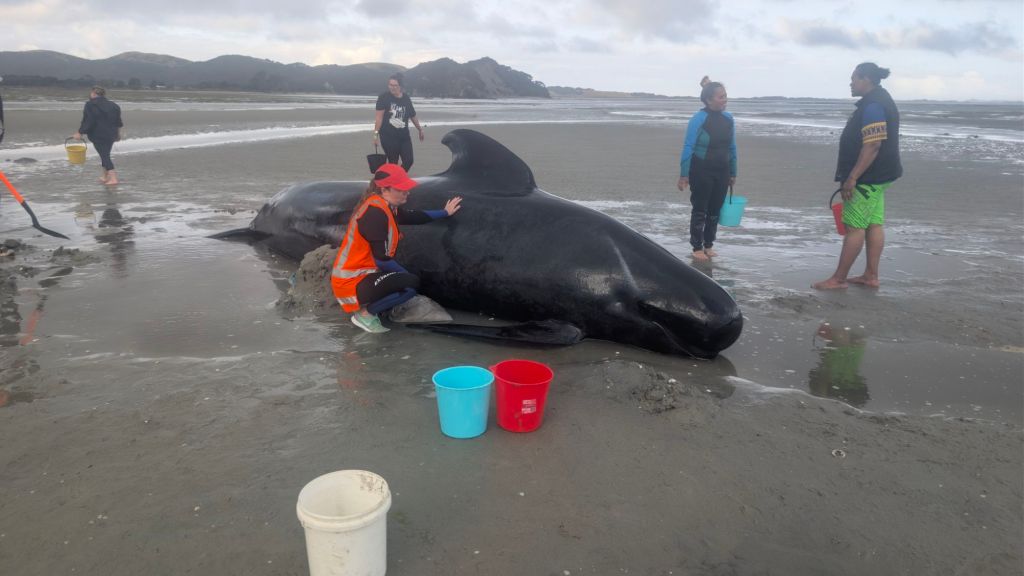
So I spent time with a bucket keeping their skin wet, being careful, as instructed, to time any bucket dumps by their blowhole immediately after they’d taken a breath.
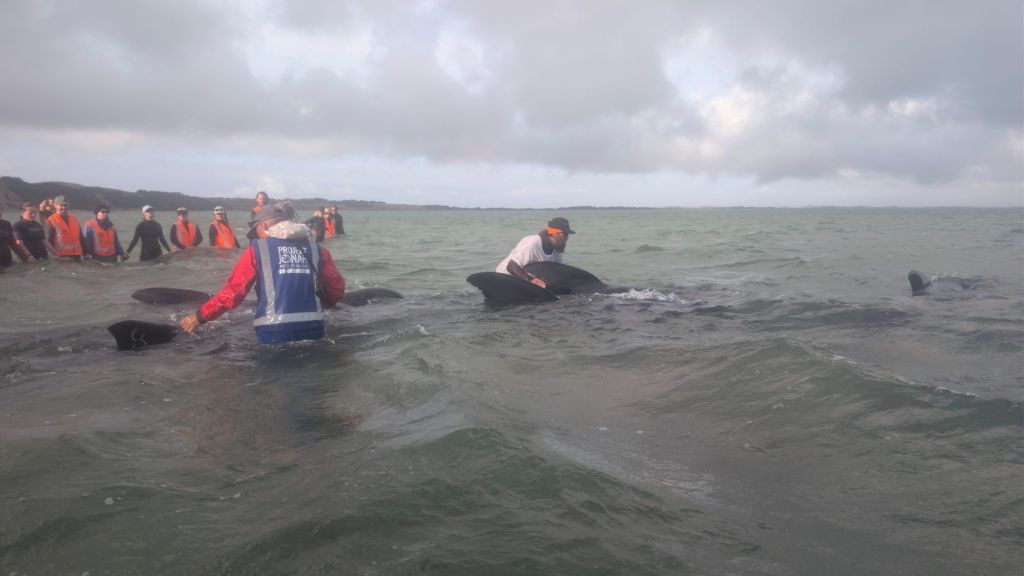
Just like yesterday, each whale had a group of volunteers who were sort of informally assigned to that particular whale– keeping it wet, keeping it upright (if possible), and when the time came, helping to put carry straps under the whales to be ready for repair refloating as the tide came in.
So I worked on those tasks until I was asked to participate with a group that was putting one of the whales on a pontoon.
There were actually two whales that were going to be placed on pontoons, the two that had been identified as being the most likely pod leaders.
The hope was to get those two whales on the pontoons and out into the ocean first, meeting up with a boat that would then take the whale further into deeper water and away from the death trap shallows, with the rest of the pod hopefully following the leader.
That involved placing straps underneath the leader whales, attaching those straps to the pontoon bags, and then once the tide had come up enough, filling the pontoons with air, and bringing them out to sea first.
We would take them out to the deepest water that was safe for us to be in and there meet up with the boat. Once the pontoon was connected to the boat, they would take it further out to sea, and we would go back and help the other teams help their whales follow the leader.
Once all were refloated, we would repeat the same human chain efforts we did yesterday.
I don’t know if I mentioned it yesterday, but if you don’t already know (I didn’t), even though they’re called pilot whales, they are technically members of the dolphin family, the second largest member, in fact, with orcas (killer whales) being the largest.
Anyway, so they taught a few of us (myself included) how to set up the pontoon stuff, rolling the whales on one side and placing half of the rolled up carry strap underneath (the half that’s still rolled up going under the whale as far as you can get it), and then rolling the whale to its other side, so volunteers on the other side of the whale can reach in and grab the rolled up portion of the carry strap and unroll it.
After getting the carry straps placed, we connected them to the pontoon bags and waited for the tide to come in.
As the water came in, someone came by with a tank to air up the pontoons, and once we had enough water to begin floating the whale out, we began leading the whale out to deeper water.
Prior to the tide coming in, someone is sent out with shovels with colored handles to mark the deepest channel out to deeper water. As the tide comes in, only the colored handles are visible above the water, but that lets you know what path you need to take to most easily get the whales out to safety.
The moving of the whales out to deeper water went super smoothly today, we with the pontoon whale meeting up for the hand off with the motor boat, as well as the other teams with their whales, which was encouraging.
After we got them out to a depth where they could float and swim on their own, they took almost no time at all acclimating, which was quite encouraging.
Yesterday, it seemed like it took an hour plus just waiting for them to regain their bearings–watching them flop over on their sides, over and over, etc. (except the juveniles, they were up and going pretty much immediately both days).
Today, I think it might have been a grand total of 15 minutes that we waited for them to get their bearings, and then they were all set and ready to go. 🎉
We made our human chain again, and as we watched them swim out to deeper water, were hopeful that today might be the day they finally found their way away from the death-trap zone.
As we headed to dry land, I started chatting with a woman named Marija, an Italian woman who now calls New Zealand home and who was a fellow unofficial volunteer today.
We chatted and got to know each other a little bit as we walked along the beach back toward the car park.
As we were chatting on the way back, I saw Nick, my new Danish friend (whom I met last night and whom I’d texted earlier today about the renewed whale-rescue opportunity) walking up the beach toward us!
I gave him a hearty welcome, and we all chatted together as we walked back to the car park. We talked and laughed and joked and enjoyed each other’s company for a little while until we got word from the Project Jonah peeps that all 15 of the whales that we had just barely refloated had re-stranded just a couple of kilometers further west (near Pūponga).
Brutal.
😞
Apparently, the leader (“pilot”) mistook a deeper channel in the sand, made by a river entering the sea at low tide, as a way to deeper water (that channel is the deepest spot screen at high tide, and they were stranded while trying to go up the channel).
😞
Once again caught by the brutal nature of the undersea terrain and resulting tidal ridiculousness in this death trap of a bay.
Anyway, with the news of the restranding, the rush was on.
Once the tide reaches its peak, it goes back out crazy quickly because of how shallow the bay is (as I mentioned yesterday and showed in the pictures).
Some people were saying that it can go out at walking speed–meaning you could go to the edge of the water and start walking out to sea as the tide went out, and you’d never actually walk into the water because it would be going out away from you at the same speed you were walking toward it.
😶
I don’t know how accurate that is, as I have never tested it myself, but that at least illustrates the urgency the circumstances dictate.
It really was go time if we didn’t want the poor creatures stuck for what would likely be another nearly 25 hours.
Many volunteers had already left the area by that point, but the three of us, still on site, decided to book it over with the remaining volunteers, official and unofficial, to give refloating them one last go the day before it was too late.
If there was a silver lining, it was that Nick was able to help this time, which was a special experience for him (as it’s been for all of us). 🤍
Parking was a little challenging, as we had to park on the side of the road, but there wasn’t really a shoulder to park on, so I just drove my van into the grassy hill next to the road, with my van at a pretty hefty tilt back toward the road, but at least it wasn’t in the road.
I got my wetsuit back on and headed back out, a race against time.
Nick didn’t have a wetsuit, so he would only be able to help as long as he could stay warm, which isn’t easy in the cold water. 😅
But Nick, Maríja, and I (and many others) went out again and worked as hard as we could without really much opportunity to rest, because every minute that you spent not actively getting them out to deeper water meant you were losing ground as the tide went out.
You couldn’t just get them to water deep enough for them to move, you had to get them to that water and then keep them moving in the correct direction.
Not easy when they’re super family oriented and don’t want to leave any members behind.
We worked and struggled–repositioning, lifting, and pulling, racing against the tide. I was with the portion of the group of volunteers working with the whales furthest from shore, and thus, with the best chance at successfully refloating.
Nick busted his butt until he had to go in to get warm, and Maríja and I stayed out (benefits of having wetsuits).
Amazingly, we were able to get 10 of the 15 refloated again 🎉.
Unfortunately, five were hopelessly stranded again, so we knew that, barring a miracle or all of them dying, we’d need to care for them all day tomorrow and attempt another refloat yet again in the late afternoon.
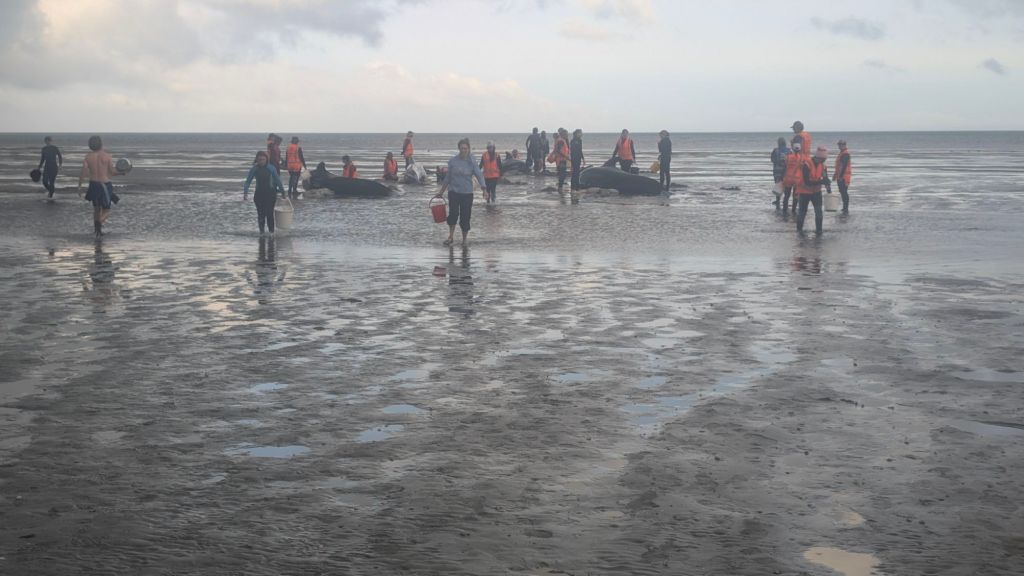
Certainly, the next high tide overnight could allow them to escape back out to sea, but that seems to rarely happen in this area. Not only that, but we are in the part of the tide cycle where each successive high tide is lower than the previous.
Not a good recipe for natural rescue. 😕
Crappy tidal timing. 😞
We were hopeful, however, as the 10 whales that we’d refloated for the second time today actually swam off in the right direction. 🎉
Oh, how I hoped at least those 10 make it out to deep water tonight. 🤞
After that second rescue effort, Nick, Maríja, and I headed back to the field that’s acted as a volunteer base camp for volunteers helping with the rescue efforts.
Collectively, the three of us decided to stay to help with tomorrow’s rescue, and since we were staying to help again in the morning, the department of conservation allowed us to spend the night there in what is normally a freedom-camping-prohibited area
We all parked near each other and spent the rest of the evening hanging out, eating, getting to know each other, chatting, laughing, and just generally enjoying ourselves.
Good day today. Ups and downs. Highs and lows. We got word about 7:45 that the 10 that we had gotten refloated for the second time today restranded for the third time today.
It’s a privilege to be a part of these efforts, but it’s certainly a downer to hear about the restrandings.
Oh! I forgot to mention that for day two, I wasn’t wearing my water shoes well doing all the rescue work. They’d been a little bit awkward to wear yesterday through the ocean (all the shifting side to side, the drag, etc).
There was an unintended consequence of that, however. Apparently, stingrays were pretty common in this area, so without my shoes, the recommendation was to shuffle my feet quite a bit as I moved around in the human chain and what not.
Constantly rubbing waterlogged feet against sand tends to reduce your skin cell population. 😅
Lift the world.
Bring it on.
~ stephen
 Lift the World