(written on February 18th from notes taken previously).
Tough, exhausting, frustrating, exciting, discouraging.
We were up super early this morning, somewhere around 5 or 5:30, I think? to get the news and to be ready to go to work.
The news wasn’t great.
The biggest of all of the whales from the pod of 15, the one that had been leading the pod up that river channel, had died overnight, leaving four left in the Pūponga area that survived the night but hadn’t been able to escape on their own with the overnight high tide.
What was doubly discouraging was that the 10 whales that we had successfully refloated and that were swimming in the right direction as we packed it in last night, had once again fallen victim to the Farewell Spit death trap, heading toward shore, up another channel that was just slightly deeper than the rest of the sea bed.
Heartbreaking to think about what it must be like for them, trying to find their way out, and being unable to every single time. 😞
Not only had they restranded, but one was missing, as there were only nine.
Sure it’s possible that one of them had managed to make it to open water, but it was more likely that the missing one had died and was simply not with the others. 😞
So we were down to 13 (10 adults, and three juveniles).
Incredibly, the surviving whales were in remarkably good shape for it being their fourth straight day of stranding.
One of the official Project Jonah people mentioned that we don’t really know the physical effect lying on the beach without the supportive buoyancy of water has on their internal organs.
Clearly, we know that they’re not getting any food or water, and clearly their skin burns and peels in the sun, just like ours (a heartbreaking and sobering sight to see and one of the reasons sheets are placed over their bodies as they are rinsed down with water over and over again to help them survive the sun).
When things get really bad, the pools of water that surround the whales can be red with blood.
😞
Fortunately, that wasn’t the case with any of our whales today and hasn’t been the case for any of them during these four days of rescue efforts. 🙏
Anyway, our first efforts this morning (after initial assessments taken of their well-being indicated that they were indeed healthy enough for another attempted refloating) were to try and prop up the whales that were tipped on their sides (caused by the uneven ground as the water receded and their bodies settled).
You can try and use bare sand to prop them up, rolling them to one side and putting the sand underneath, but I think more often than not, it requires filling sandbags with sand, rolling them over a bit, and then placing the sandbags underneath them, so when they roll back over, the sandbag keeps them upright.
You also have to make sure their fins are properly oriented, so as to not hurt them when rolling them.
One of the other challenges with this type of setup, one that I hadn’t had to deal with because I hadn’t been there for any of the morning efforts until today, was simply getting water to keep the whales wet.
When the tide goes out so far, your water source can be a good long way away, which requires getting shovels and digging little mini wells to gather water from.
As the whales had again tried going up a lower channel in the seabed, once the water had retreated at low tide, that lower channel became the main drainage basin , so to speak, for a very large section of the newly exposed sea floor.
Watching all of the water collect and run down the channel as a little river right next to all these stranded whales, one of the official Project Jonah coordinator people and I had the idea of maybe trying to dam up the river.
I know, I know, Stephen and his dams. 🙃
So he and I grabbed shovels and started going to work.
Super close to where all the whales were stranded were large patches of some sort of short sea grass or something, The roots of which made it possible to dig up chunks of sand that held together decently enough to stay together even with the water from the little tidal river hitting them.
The river we were trying to dam up was maybe… five meters wide?
We worked and worked, and we were making great progress, he working from one side, and I from the other.
It wasn’t a very pretty line, more of a disfigured u-shape, with the bend on the upriver side, but whatever. If it worked, it worked. 🤞
And indeed, it seemed as though we might be successful, as the dam started working well enough for the water to begin backing up a bit behind it. 🎉
But we ran into a pretty significant challenge when we tried to actually close up the dam. The water, flowing from up the beach toward us, was beginning to become quite powerful, and with the dam forcing all the water to escape from one spot, no matter what we did, it was so powerful, that even our chunks held together with roots couldn’t withstand the pressure and just got washed away.
It seemed like our efforts to close up the dam were hopeless.
We had managed to raise the level of the water in the area a little bit, and that was great. It did make it easier for people to gather water, but we were still losing pretty much all the water as it simply continued down the channel and out to sea.
Unable to find any way to reinforce the center of our dam, I had the idea of using my body to complete the dam, so I gave my shovel to somebody else, and I lay down smack dab in the middle of our dam, completely blocking the opening where the rushing water was escaping.
My hope was that with me there, they might be able to backfill on the upriver side of me and connect the two sides of the dam.
It worked! 🎉
They were able to pile enough of our little root/sand chunk building material behind me that instead of just pouring through the center of the dam as it had been doing before, the dam was now functioning as an actual collection basin. So effective was it that the water began pouring around the edges of the dam.
🥳
Most importantly, that meant that the volunteers had a continuous source of water at their feet to fill their buckets with to keep the whales wet.
🥳
I think that it was around that time, shortly after we had gotten the dam to what felt like a fairly stable place (not collapsing under the pressure of the water behind it), as I was looking around (down the beach, up the beach, and out), I saw the missing whale off in the distance.
I had actually been looking for it repeatedly throughout the morning, periodically just looking up and taking a glance around, and then putting my head back down to work.
At one point much earlier in the day, I thought I might have seen the missing whale, but when a couple of people went out to check, it wasn’t our whale. This time, however, it was clear that it was a whale.
I mentioned it to the project coordinator (the one I had begun building the dam with), and we walked out together to check to see where we were at with that one.
Sadly, as the project coordinator suspected, the whale was indeed dead, likely having died from exhaustion and starvation and whatever else despite still being in deep enough water to swim.
He took some pictures to identify which one it was, and then we walked back to rejoin the others and continue our rescue efforts with the surviving whales–I continuing to focus mostly on the dam-building efforts.
Those of us building the dam didn’t stop after our success at creating our little pond: No, we just kept building and building and reinforcing and reinforcing and expanding it outward on both sides.
With the success of our little dam-building project also came a significant increase in the sheer volume of water being built up behind the dam, and eventually, we had a collapse right in the middle of the dam, I think at or near the same spot as before, the water rushing through, taking a large portion of our dam with it as it gushed through. 😬
Once again, I jumped in as a human dam to stop the destruction and give hope and opportunity for reparation.
With the water as deep as it was, we needed something better just piles of loosely held together sand to stop the onslaught of water. Somebody had the idea to use the extra buckets that weren’t being utilized to keep the whales wet.
They brought them over, filled them with sand, and placed them next to my body to rebuild the broken portion of the dam. Once the buckets were filled and in place, backfilling them with our building chunks worked like a charm. 🥳
In fact, so successful were our dam-building efforts, that the little lake we had made had backed up so much that even whales that were on the highest ground were at least partially in water!
Everything was going so incredibly well. 🙏
Having been out there since early morning, spending most of my time feverishly digging to build the dam, some of the official project people started encouraging me to take a break.
I didn’t want to, but they were right to encourage me to do that, so I hopped on the little 8×8 that they had out there and got a ride back to base camp.
It’s hard for me to take breaks when work still needs to be done. 🙃
I also wanted to see the reaction of the Project Jonah leader who had been the one working with me to start the dam. He had also gone for a break earlier, and the dam had gotten so much bigger and deeper since he’d left.
I think it was around that time that Nick and I had sort of a fun thing happen. Ever since I was a youth, I’ve gotten in the habit of giving both objects and friends nicknames, and yesterday, I’d given Nick the nickname of “The Viking,” or “Nick, the Viking,” and I started referring to him by that nickname, I think maybe often using some funny accent or another. 🙃
Well, today his nickname sort of went viral in our local volunteer group as people started calling out for him: “The Viking! Where’s the Viking? We need the Viking!” 🙃
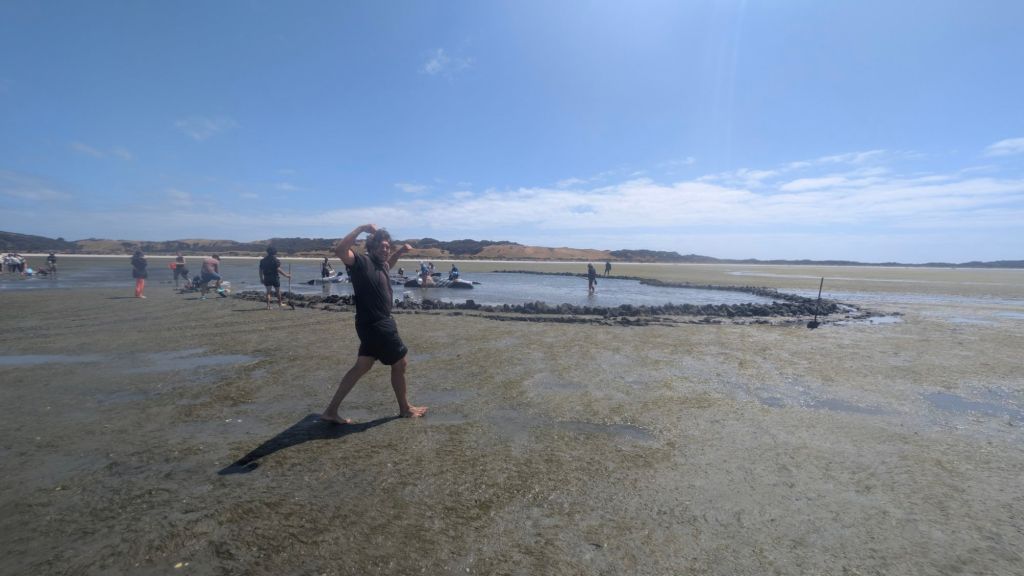
Fun. ☺️
After taking a short break, I headed back out, this time with my backpack full of water and granola bars inside, propping them up on a bucket, so as not to get wet.
I jumped right back into the dam work, joining volunteers who had continued working to build up the dam while I was on my break.
It was awesome.
So successful had been our collective efforts, that all of our original excavation grounds were now under water!
That was both amazing and also concerning to me, as our hidden excavation holes we’re deep enough and sharply dug enough that people could sprain, perhaps even break an ankle if they stepped into one just so.
Accordingly, I enlisted a handful of people to help me shuffle our feet all around the little mini lake to find and fill in all holes of concerning size.
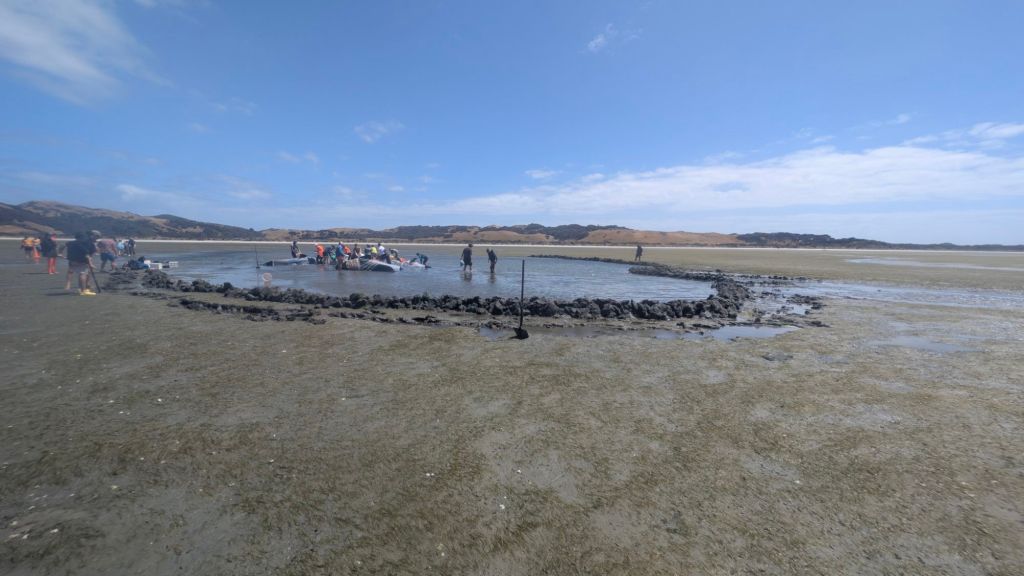
Looking at the product of our efforts, I had a pretty good sense of accomplishment and optimism.
We had put forth a huge effort.
And we were seeing amazing results.
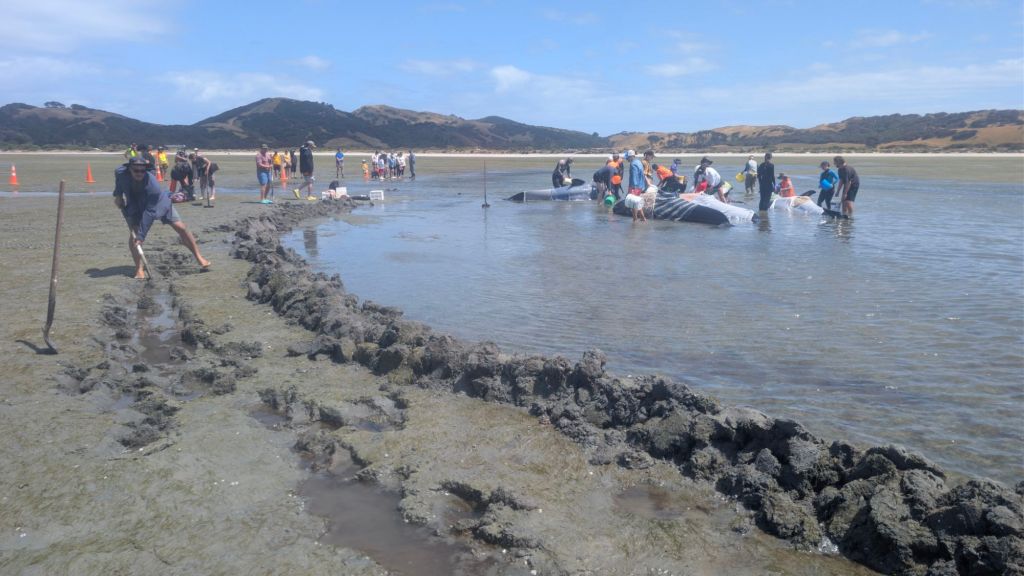
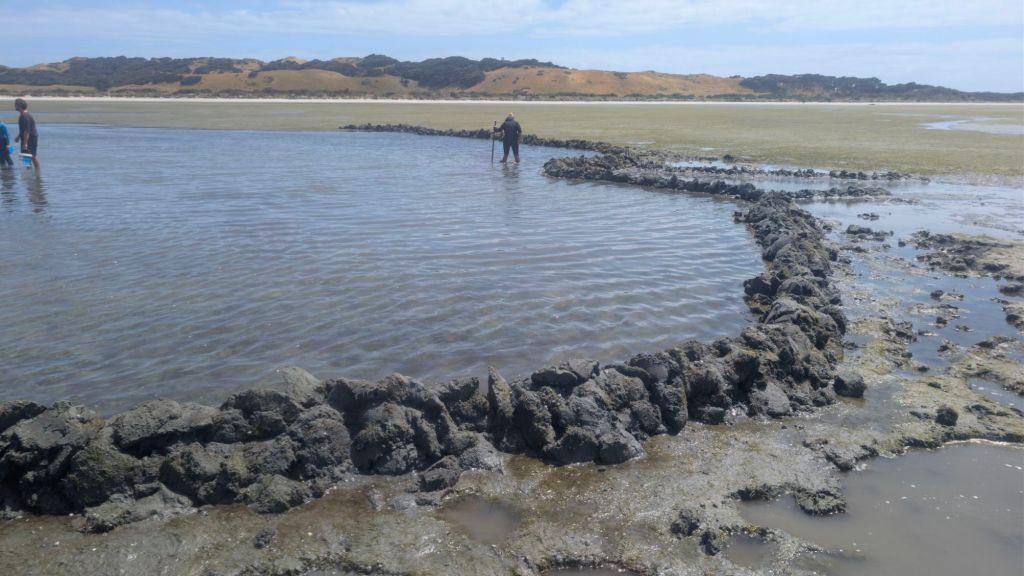
With the dam, taking care of the whales was so. much. easier. …and I think it might have helped them the whales feel a little calmer?
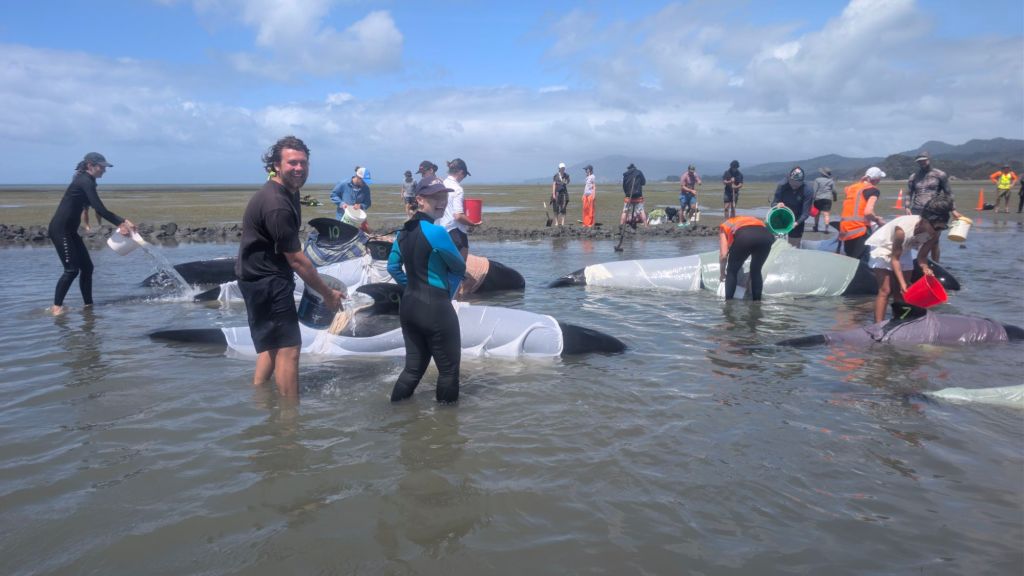
Who knows. That could just be wishful thinking on my part.
With everything going so well, I brought my phone out and put it in my waterproof case and started taking some pictures. I hadn’t really gotten almost any pictures at all for my first two days of the rescue (Days two and three of the overall effort), so it was nice to get some pictures. A little foggy, perhaps, being inside the waterproofish case, but some pictures is definitely better than no pictures.
I helped to place the marking shovels as the tide began coming in, and then, once the water was high enough to breach our dam in the opposite direction, a group of us got together and began dismantling the dam, as the area where the dam was built needed to double as the escape channel.
Of course we knew that from the moment we started building it, so it wasn’t a surprise or a disappointment. There was simply gratitude that we had been able to build it and that it had been so helpful for our rescue efforts, and now it was time to take down.
So big had our dam become that multiple buckets were so buried that we didn’t even know where they were. 🙃
We didn’t have the assistance of any boats today, so it was just us and our best efforts.
One by one, we began bringing the whales from their resting spots to the channel and out, I acting a guide, so each team and their whale new where the deepest portions of the channel were.
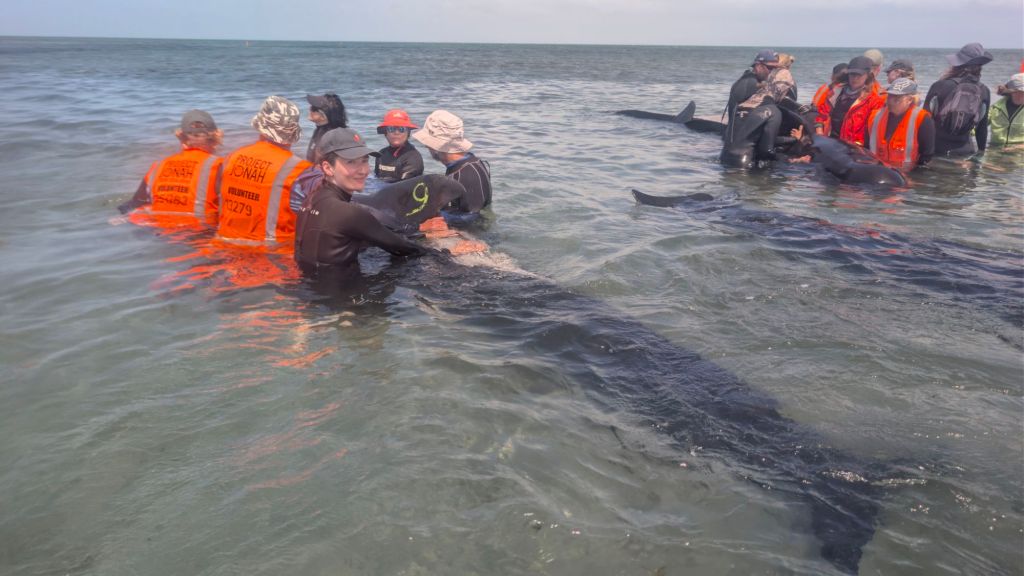
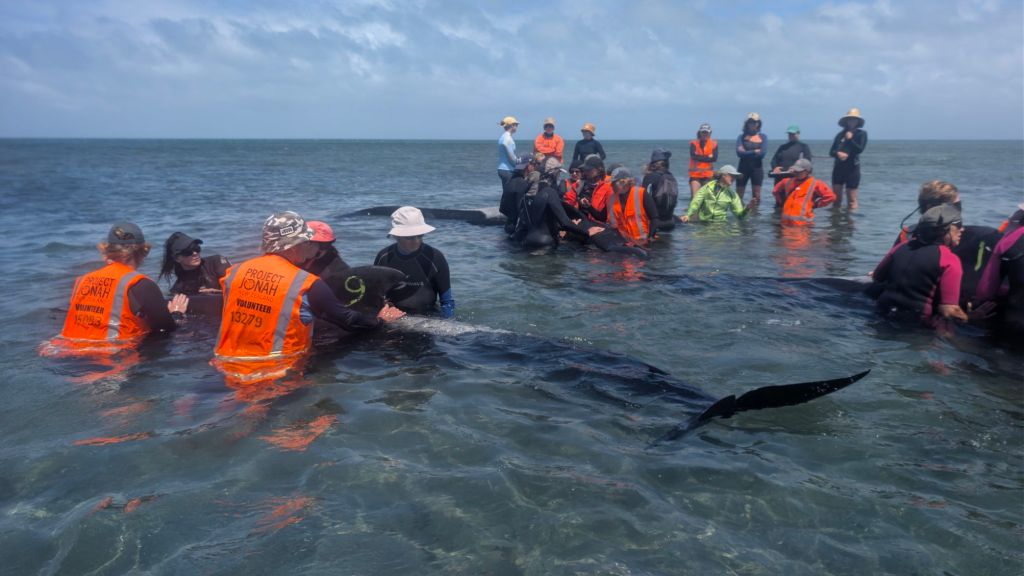
As with every other day, the juveniles were the first to get away, hanging out together but wandering all over the place. They re-beached briefly on our dam leftovers, as they left the main channel, but we were able to get them off quite quickly, and they just sort of swam all around us as we worked to get the adults out.
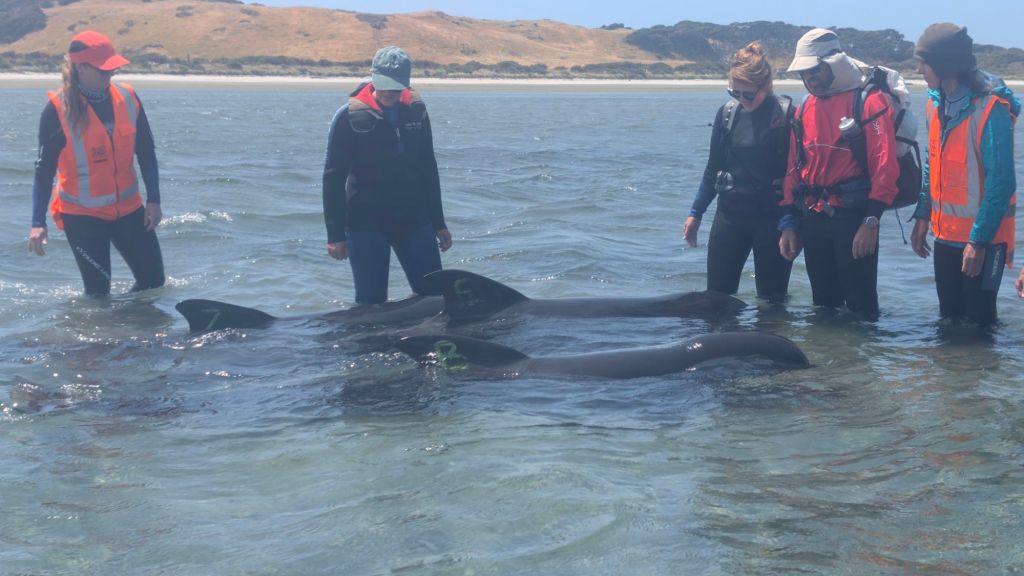
(unsuccessful corralling attempt 🙃)
It was neat to see how family oriented they are, one of the juveniles wanting to snuggle right up to one of the adults, presumably a parent.
While we had all been working in this area, there had of course been volunteers working at the other site where the other four whales remaining surviving whales were stranded.
The goal was to have us bring our whales out to swimmable depths and to have the other group get their whales out to swimmable depth and to have their group of four swim over and meet up with our group of nine.
Once out to swimmable depths, whales were pretty disoriented, kind of like my first day, taking quite a while to get their bearings.
Just like the previous two days, we made our human chain, trying to block them from going back towards shore but trying to avoid concerning them by encircling them, so the line sort of alternated between being a roughly straight line to being more crescent-moon shaped.
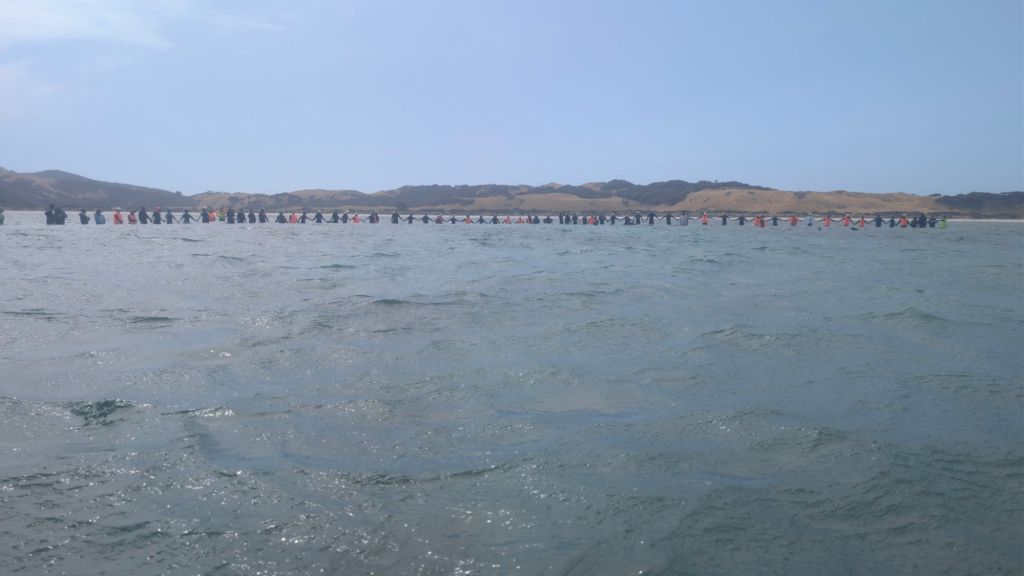
I was wearing my water shoes today, so there was less concern of stingrays being a problem, but we did indeed see stingrays going back and forth as our human chain shifted from side to side.
And holy moly was there a lot of shifting today.
The initial hopes of joining the group of four with the group of nine succeeded, gratefully but not before the four had re-beached themselves and needed to be rescued again, members of the other group sloshing through the ocean for 2 km in order to get them out again.
Eventually, though, they all met up together and seemed super happy to be back together.
After their little reunion, we worked to get them toward deeper water, and then the battle was on. More than either of the other days that I’d participated in the rescue, today was brutal for trying to keep the whales from taking wrong turns.
Clearly they had no idea where to go in the stupid shallow waters. 😕
They would go one direction for a certain way and then try and come in, and we’d race over to head them off, and then they’d go the other direction a certain way and then try and come in, and we’d head them off.
The pattern was clear. No matter what we did, eventually, they were going to try and head toward the beach.
I wondered if perhaps they were disoriented by the crazy nature of the landscape, thinking that open water was toward shore. Farewell Spit is something like 34 km long at high tide, I believe.
And it’s crazy skinny, so there is open water just on the other side of its whole 34 km length.
Anyway, our corralling efforts today started becoming a little frustrating for me. Perhaps it was just a small sample size of my experience, but it seemed enormously clear to me that we couldn’t just stop and wait for them to go out to sea each time they started swimming parallel with the shore for 3 days in a row, they had always turned back toward the beach after swimming parallel toward the shore, and every single time today they would swim parallel to the shore for a little while and then try and come in.
But the official volunteers directing the human chain kept telling us not to form a crescent moon shape but to just wait for them to find their way out to sea.
It seemed to me that that clearly wasn’t working. They seemed so worried that if we were to get in a half circle and slowly walk them out to deeper water, that somehow they would take that as aggression and get defensive.
That just… didn’t make logical sense to me at all, especially after they know we’ve been helping them for days in a row.
So it was frustrating to continually be told to reform the line instead of being allowed to slowly nudge them to deeper and deeper and deeper water.
It was also frustrating that each time they would get out to deeper water and would start swimming parallel with the beach one direction or the other, that they had us just sort of stop following the whales.
Their behavior indicated with near certainty, at least in my mind, that if we didn’t corral them, they were going to come right back toward shore.
Which they did over and over and over again.
Multiple times, I was the only person far away from the rest of the group who had booked it over to head them off.
It was absolutely utterly exhausting, charging as quickly as I could through thigh-to-chest-deep water to head them off, but I was successful. 🙏
Then they would head the other direction, and there were seemingly only three or four of us who understood that we had to keep up with them in order to ensure that they wouldn’t mistake a deeper channel for the way out.
I’m sure that probably sounds arrogant, but it was super frustrating for me to feel like the group leaders were holding everybody back from doing what needed to be done to save the whales.
It seemed pretty clear to me that the best bet for saving them would be to get in a crescent-moon-shaped line, and slowly, walk that crescent moon-shaped line out to deeper water.
Then, we would need to follow them if they went parallel with the coast, whether that be east or west, perhaps for the entire length of the spit. 😅
But I wasn’t in charge. 🙃
The concern was for the safety of the volunteers?
I don’t know. I didn’t want to rock the boat too much.
There was one point where one of the ladies was calling at me to come in and I kept giving her a thumbs up and calling back that I was coming in, but she didn’t understand that I was indeed coming back in (I was walking backward because I was so exhausted and wanted to use different muscles), and she kept calling for me to come in.
Frustrated that I couldn’t seem to communicate to her that I was indeed coming in, I finally loudly even louder.
Unfortunately, I think my frustration, both from what I perceived as being a failed strategy and from the inability to communicate came out in the tone as I yell back even louder to make it clear that I was going back. 😕
I think we were probably out there for hours, I racing west and then east and then west and then east, trying to head them off, trying to keep them going toward deeper water.
All told for the day, my pedometer showed that I walked something like 12 kilometers, I think the majority of that in knee- to chest-deep water.
Eventually, after spending who knows how much time racing back and forth, so exhausted that I was functioning from sheer will power, tasting the ketones in my mouth, and after I think one or two false rescue-effort conclusions that required hurrying back out to deeper water to head off the whales after being told to go ahead and pack it in, we were finally done.
The whales were heading east, which, although not optimal, was at least toward the opening of the spit to the open ocean.
They certainly could restrand, but regardless what happens, I think today has to be my last day helping, as my back is just hammered from lifting whales today and from all of that digging.
Honestly, I’m kind of surprised I didn’t hurt my back the first two days of carrying whales. 😅
Hopefully, the whales make it to freedom. 🤞
The worker that I had started building the dam with, I wish I could remember his name, got his drone and was following the pod out to sea, and a few of us hung out on that end waiting for word before being told around 7:30 p.m. that the whales were heading in a good direction and continuing in that direction.
It was a super hopeful time. The whales had gone to deeper water than I think at any other time during the three days that I had been participating in the rescue efforts, and they were heading in a hopeful direction, going further away from their stranding spot then they had the other days.
It seemed as though they had finally gotten their bearings, knew where they needed to go, and were on their way to safety.
It was exciting. 🎉🥳🙏
I walked toward shore chatting with a woman named Melanie whom I chatted a little bit with during our human chain efforts. We were super far away from the car park, having followed the whales for a significant ways down the beach.
I wanted to take the group by truck along the beach to continue to make sure that the whales wouldn’t just turn back toward the beach way up the spit, but I wasn’t in charge, and the majority of the spit is Maori-only land, I believe–the general public not allowed on it.
I’m not exactly sure how that works, but I believe that’s the case.
Anyway, I chatted with Melanie as we walked in, and then, gratefully, we got a ride back by truck to the car park.
It was there that I met back up with Nick (without a wetsuit, there was only so much that he was able to do once we were all out trying to guide the whales through the water). My memory isn’t working so well right now, but I think Maríja left relatively shortly after we got back, as she needed to be in Nelson to pick somebody up before driving all the way to Christchurch. 😅
She had already stayed a lot longer than she originally intended.
Anyway, Nick and I said goodbye to Maríja, and then he and I and some of the other volunteers all pulled our lawn chairs in a circle and hung out for the next few hours, eating and talking and whatnot.
There were people from several different countries all together just chilling and chatting.
It did get a tad uncomfortable for me when a significant portion of the conversation turned into Trump bashing.
I’m certainly not a Trump fan (quite frustrated/angry with his Greenland rhetoric right now, for example), but the news that people in Europe get (based on the near-homogeneous sentiment I feel I see from Europeans?) seems to pretty much follow the “news” put out by the furthest-left-leaning of the news outlets in the United States, and that can be… challenging. Generally, in those situations, I just ask a lot of questions to better understand. Sometimes I’ll add data if it seems warranted, and sometimes I’ll ask more rhetorical/contemplative-type questions, not in an effort to debate or convince, but simply to give voice to other opinions (that I might or might not even hold) that I think help to encourage greater patience and understanding with/of others.
Nick, wonderful young man that he is (perhaps in this experience punctuated by the fact that he’s Danish), I think was a little concerned about me as the bashing went on.
He mentioned to me later that it was on his mind as the bashing of Trump (and I think of Americans as well?) went on.
Anyway, I mostly just say listening.
One lady member of the group I think might have been me eating out of a can? I don’t remember the impetus, but she offered to make me a pizza, which I gratefully accepted and thoroughly enjoyed.
She wasn’t there for most of our gathering, I don’t think. After making a pizza for me, she left again and made one for Nick.
Super nice young lady. She and her husband/partner were early 30s, maybe?
Missed not having Maríja there with us. We’d had such a great time, the three of us, hanging out together last night before bed.
Oh! One of the people I was chatting with was from Hungary, and it was kind of fun to be able to say a handful of words in Hungarian and to let her know that I had a sister who had lived in Hungary (I was texting my sister Heather a little bit while I chatted with Mariann, who was from Karcag, which is not that far from Debrecen, a town I actually visited with my sister many years ago).
Anyway, sometime pretty late at night, one of the volunteers who happened to have a $3,000 set of binoculars that could magnify I think maybe 40x? mentioned that he looked super far down the spit and saw that the whales had once again restranded.
That was… a pretty heavy blow after so much work and so much effort and so much optimism, thinking they’d finally made it.
😞
Lift the world.
~ stephen
 Lift the World