(written on February 19th from notes taken previously).
Today has been a day filled with beauty and natural wonders. ☺️
After getting up, I started driving up the road deeper into the hills toward the day’s intended destinations–several natural attractions on a dead-end road out in the middle of nowhere in the far western portion of the Kahurangi National Park.
Before descending down into the Oparara Valley where all my stops were, I pulled into a little tourist information stop (one of those places where there are permanent informational/historical signs set up for you to read but no actual infrastructure.
I had hoped there would at least be a long drop, but no such luck.
Thank heaven for Micro John. 🙃
That fantastic two liter ice cream tub has been such a boon and a stabilizing, comforting addition to my travel gear. 🙏
It might sound funny, but being able to know that I can go to the bathroom here, there, and everywhere, when and as necessary without having to feel, uh… crappy about leaving my poo somewhere, is wonderful. 🙃
Thank you, my aptly-named Groovy Gumdrops ice cream tub. 😁 (If you haven’t been on river rafting trips, then you might not know why that’s aptly named? At least on the river rafting trips that I’ve been on, the portable poo container had been called “the groover” 🙃)
Moving on 🙃… It was another rainy day today just like yesterday, but just light, gentle rain, nothing that would soak you.
Since it wasn’t a downpour, I decided to go ahead and visit all the places on my list, starting with Moria Gate Arch (which is more accurately described as both an arch and a cave).
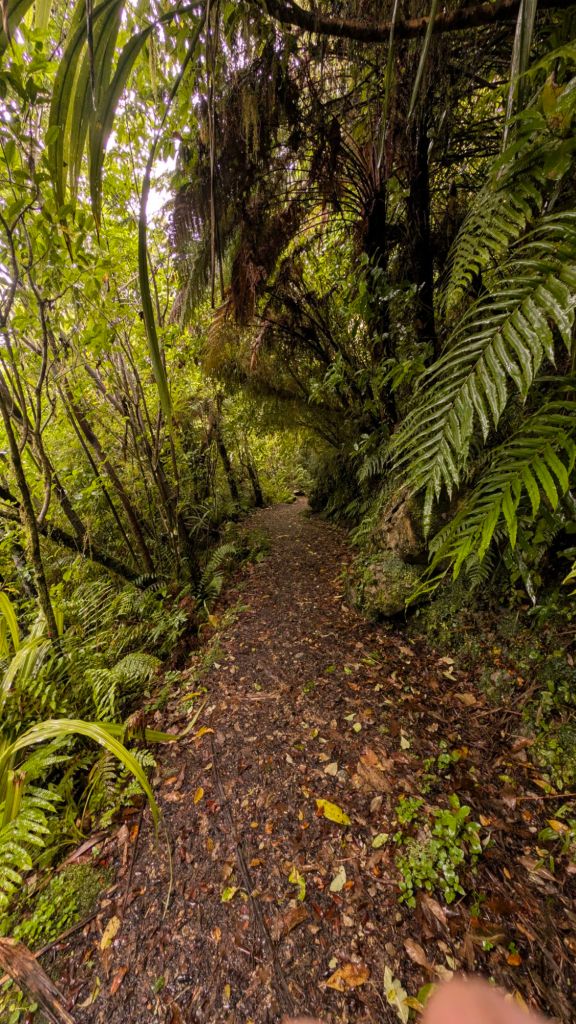
After parking in a gravel car park, I followed the roughly two-kilometer? trail, winding up, down, and around through the thick bush until reaching and descending the stone steps of the cave entrance.
There was an older couple in the cave, technologically quite well set up, by the looks of it, taking photographs, the woman right at the entrance to the cave, and the man further down by the river’s edge where the Oparara River (a dark, tannin-stained, red-brown river) flows under the arch portion of the geologic formation.
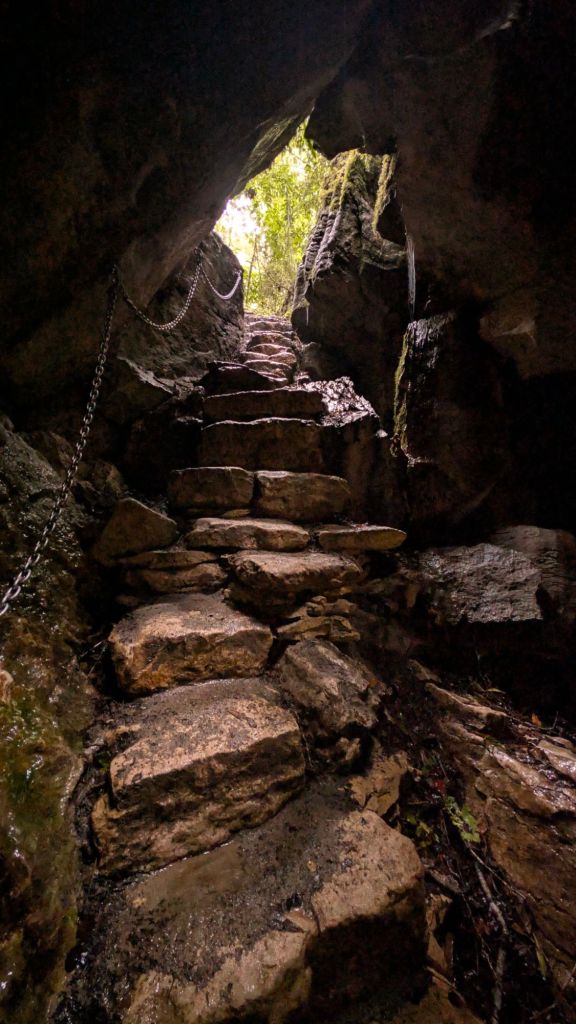
There was a mini dripping waterfall at the entrance to the cave, most likely because of the rainfall. I climbed down past the lady and started wandering through the beautiful limestone cave, over to the river and arch.
I snapped pictures and soaked in the beauty of my surroundings, spending a little time exploring the side passages of the cave portion.
Beautiful place. ☺️
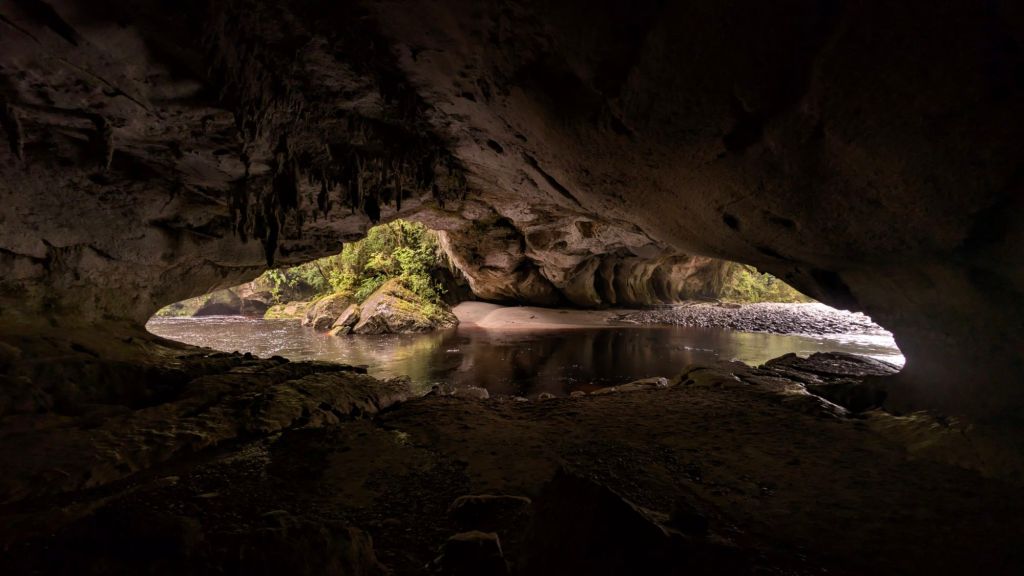
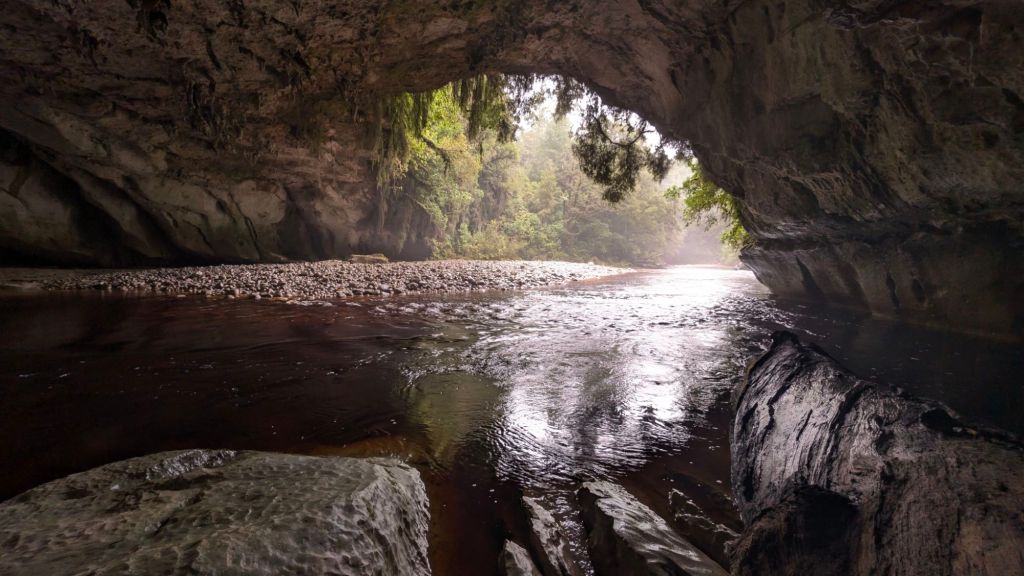
I love the look of water-carved limestone formations, the contrast of colors, the variety of shapes. To me, they have the look of intricately-designed artistic sculpture with this feeling of raw power and majesty.
☺️
Beautiful hike. Beautiful natural wonder.
My next stop, Oparara Arch, started with a trail (about half the distance of the walk to Moria Gate Arch) at the other end of the same car park.
If Moria Gate Arch was more accurately described as both an arch and a cave, then Oparara Arch, to me, would be more accurately described as an absolutely enormous tunnel–something like 219 meters long, 79 meters wide, and 43 meters high. 😲
Knock a skyscraper over, and it could fit inside.
😶
The little rain sprinkles continued but weren’t any real concern.
The trail to the massive arch/tunnel follows the same Oparara River that flows under Moria Gate Arch (the river flowing through the enormous Oparara Arch tunnel and then wind down the gorge before flowing under Moria Gate Arch.
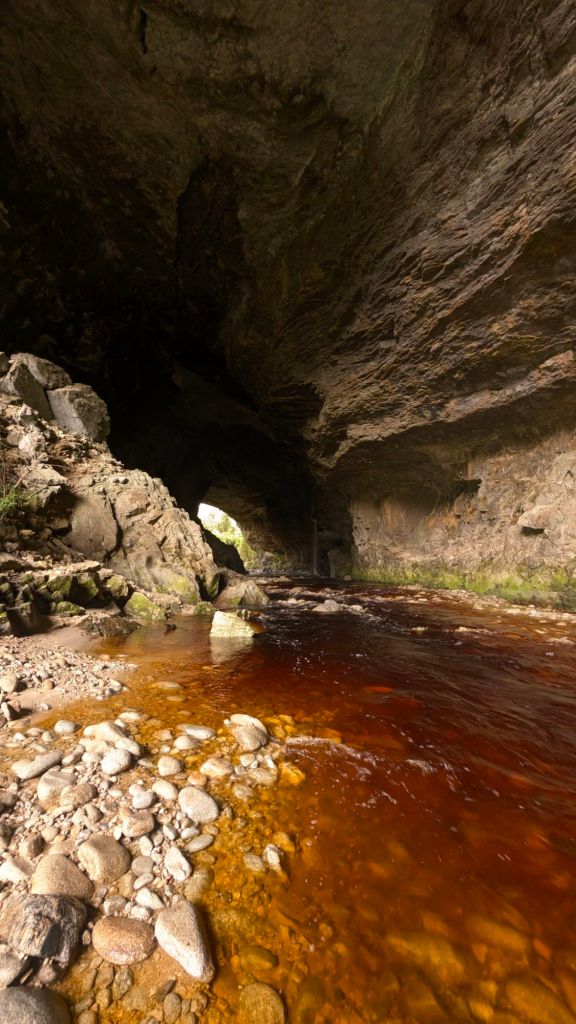
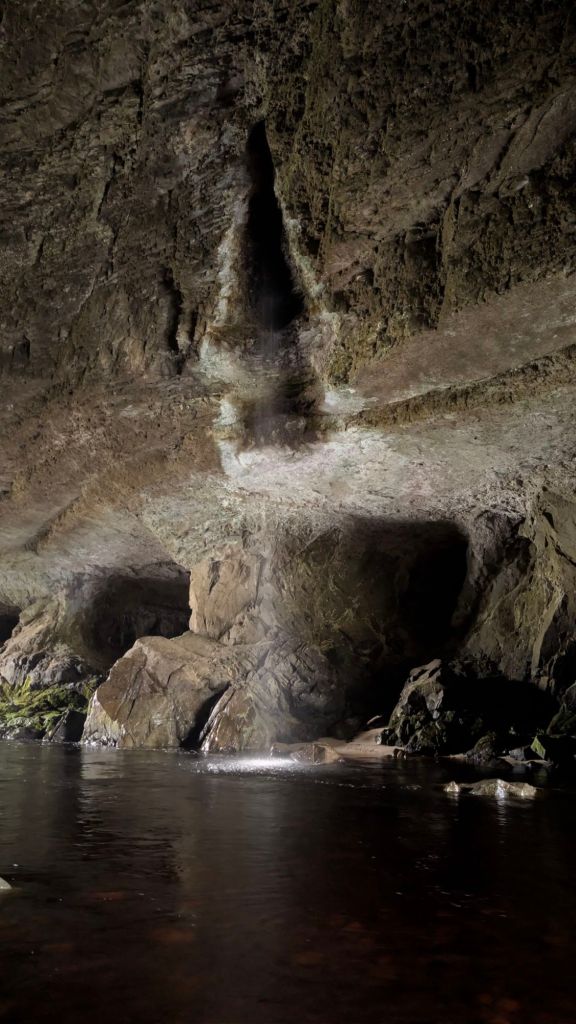
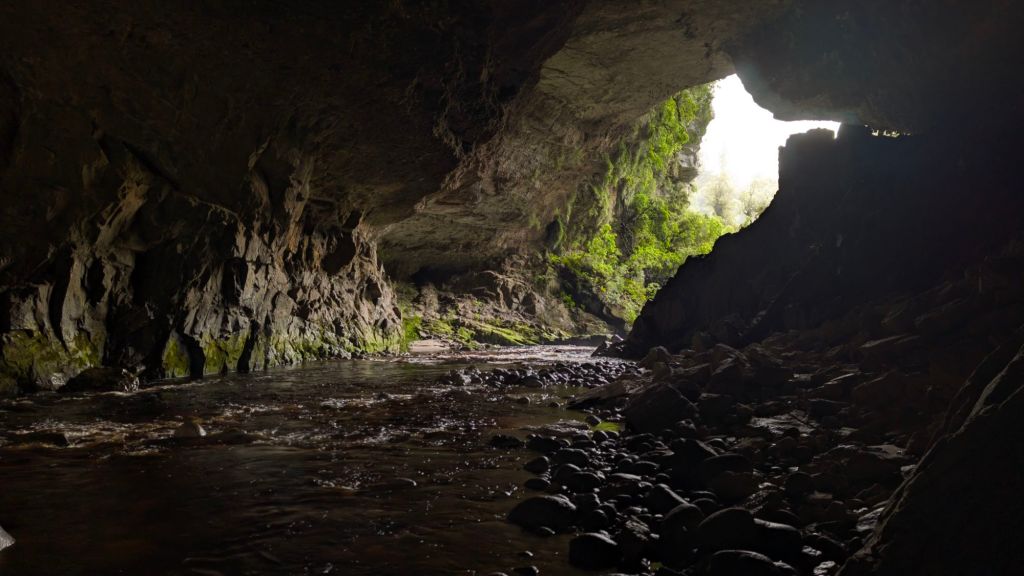
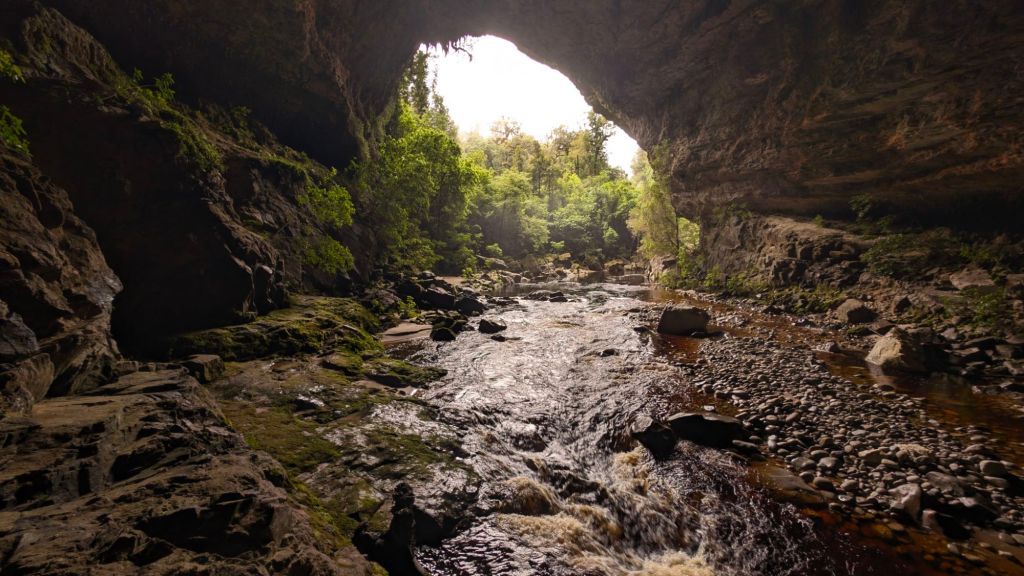
I explored the huge formation for a good little ways, pretty much all the way to the far end of the tunnel–a little bouldering, scrambling, and rock hopping necessary–snapping pictures along the way.
Somewhere around the middle of the massive tunnel, there was a waterfall coming from an invisible source high up in the roof of the tunnel.
I wasn’t feeling adventurous enough to want to cross the river and get a closer look, but I was certainly curious about the source, if one could see Open sky and the little waterfall running through a hole in the roof, or whether it was just cracks in the rock that converged to a point where the water then flowed through the roof and down to the tunnel floor and river below.
There weren’t very many tourists, probably given the day of the week and the weather, but there was a family that I got a little annoyed with as one of their kids was trying to break a rock to take home as a souvenir.
Instead of the father teaching the child to respect the land and leave it alone, the father helped the child break the rock.
I wanted to chew him out a little bit, but I refrained. 😒
Don’t break stuff. Don’t carve in it. Don’t leave your crap around.
Leave. no. trace.
End soap box.
I think part of the reason I didn’t say anything was that I’ve been guilty of doing things I shouldn’t, and I still am, just in different arenas.
The third stop (out of four) for the area was Box Canyon Cave, a relatively small but interesting cave system only a short walk from another little car park just a little ways down the road from the arches car park.
There were two named caves, side by side, on that little walk–Crazy Paving Cave and Box Canyon Cave.
Crazy Paving Cave is currently closed (and has been since June of 2022) as a scientific study is being conducted on the potential effect that tourists of the cave have on the population of Nelson cave spiders, a very large spider that I guess is seen as sort of the missing link between ancient and modern spiders.
It’s pretty huge (leg-span, at least), at 13 to 15 centimeters (nearly six inches)! It’s also one of the few protected species of spider in New Zealand, apparently quite rare.
From what I’ve read, the population went from an average of 8 in 2022 when the cave was closed to a population of 33 in 2025. 🎉
Clearly, not being able to go inside the cave, I only paused briefly to read the signs before heading over to its sister cave, Box Canyon Cave, which I’d be willing to bet big money is just a single cave system– especially after my experience inside Box Canyon Cave.
The entrance to the cave starts with a set of stairs that descend down into a larger open chamber. You can follow that large chamber back for a good little ways, maybe 100 meters?
It’s an interesting cave, as well, in a few respects.
Portions of the cave floor resemble the tile-looking dried mud of the African Savannah.
And massive sections of limestone wall that stick out up to several feet, I think, from the side of the cave, have no support!
Picture taking a refrigerator box, and gluing it to your wall about 6 in above the ground. That’s kind of what it feels like–gaps underneath the walls that make it feel like it could just come crashing down at any moment.
The cave is also interesting because of the different geologic formations. You’ve got the super hard limestone, but then if you follow some of the side passages (that aren’t listed in descriptions as even existing), you come to small tunnels where the cave walls and ceiling are made of mudstone, that you could easily just carve away with your fingers.
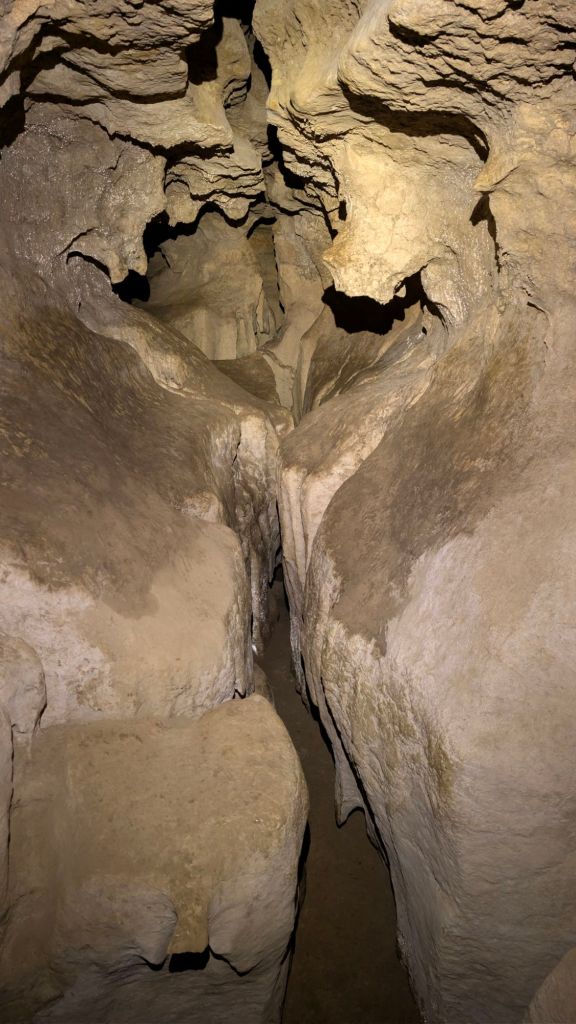
Not a recipe for feeling secure underground. 😅
I followed some of the side passages all the way to where I could see light again, indicating separate entrances/exits existed.
I was tempted to crawl through the small tunnel and out the exit, but there was a little bit of water flow, and the tunnel was pretty small, such that I’d for sure get wet, and possibly might have even had to lie down on my stomach in order to make it through.
One fun aspect of the cave was that near the entrance, I discovered a narrow opening that led to a winding slot canyon, of sorts, within the cave itself, and it was in that slot Canyon that I found myself virtually surrounded by a whole bunch of Nelson cave spiders.
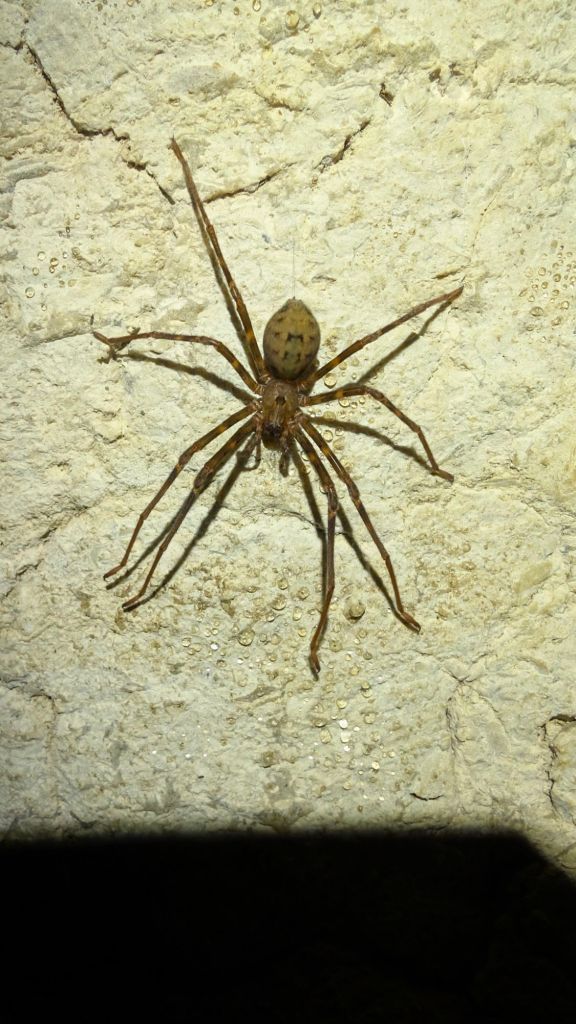
Massive critters, those!
Cool stuff.
I snapped some pictures, as I do everywhere, including pictures of the huge spiders, though I didn’t feel comfortable putting my hand next to them in order to give a sense of scale.
I had hopes to maybe check out Honeycomb a Hill Cave, but you’re not allowed to do that one without a guide, as it’s a protected area.
I guess kind of like Farewell Spit is a death trap for whales, The Honeycomb Hill Cave system was kind of a death trap for animals, with something like 70 entrances and 13 kilometers of passageways.
They’ve found the remains of over 50 species of bird, including all nine species of extinct moa (a giant, flightless bird up to 12 ft tall 😲).
Would be super cool to stop there, but it wasn’t in the cards today.
My last stop in the Oparara Valley was backtracking a little bit, along another two-kilometer? walk through the beautiful lush bush, this time to a small lake/large pond known as Mirror Tarn.
And boy did it live up to its name!
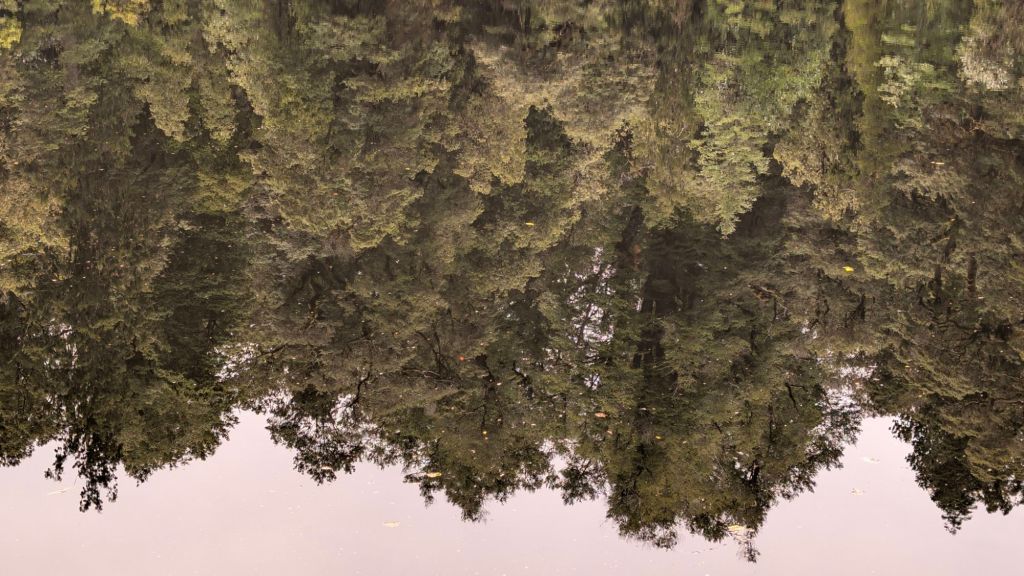
In some ways, I was a little underwhelmed, as it’s just a pond in the woods, but it was also super cool to see how pristine the reflection was off the super dark, tannin-laden water.
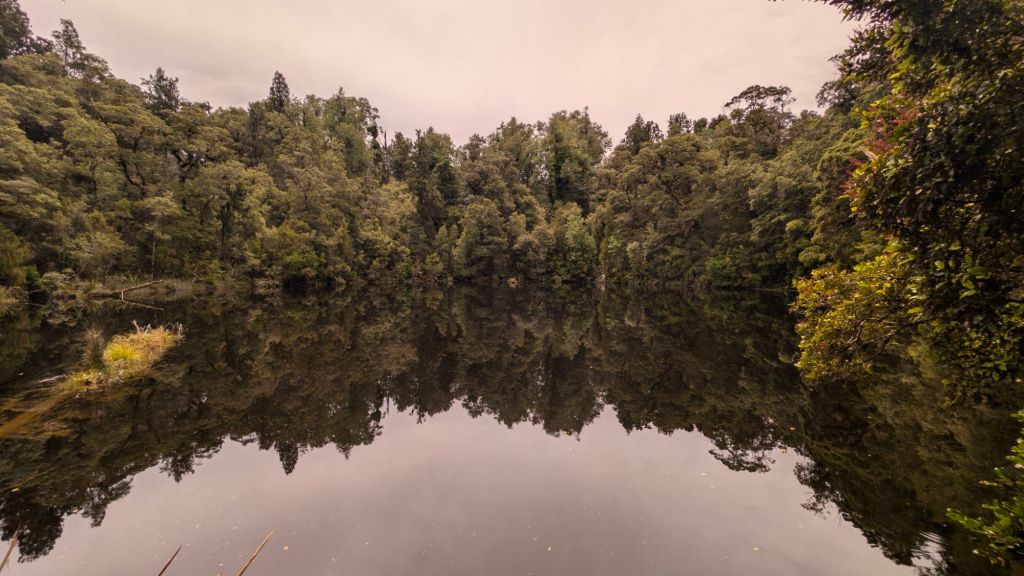
The visit to Mirror Tarn was my last stop in the Oparara Valley, I think my first walk without any rain?
From there, I drove back down out of the hills/mountains, winding my way on the dirt road toward the coast.
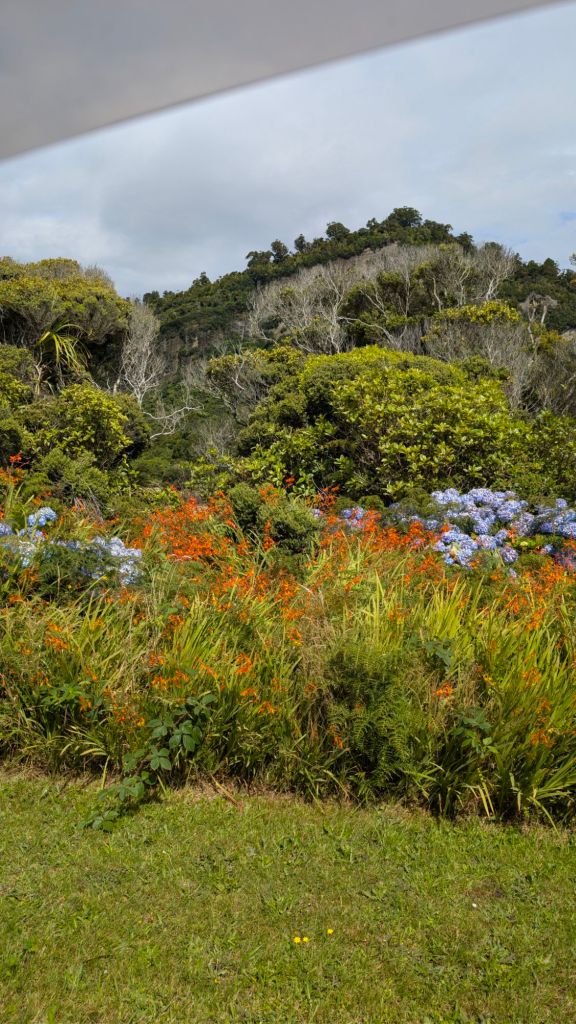
I made a brief stop at Little Wanganui Beach Reserve, where I had thought I might hang out for a while and enjoy the beach and whatnot, but it was a little crowded for my taste, so I just ended up emptying the contents of Micro John and taking some pictures of the beautiful flowers along the dirt road. 🙃
From there, I headed south down the coast, finding a little spot on the beach in Hector, where I parked my van on the dirt overlooking the water and just chilled inside my van, enjoying the view and veging out in my van.
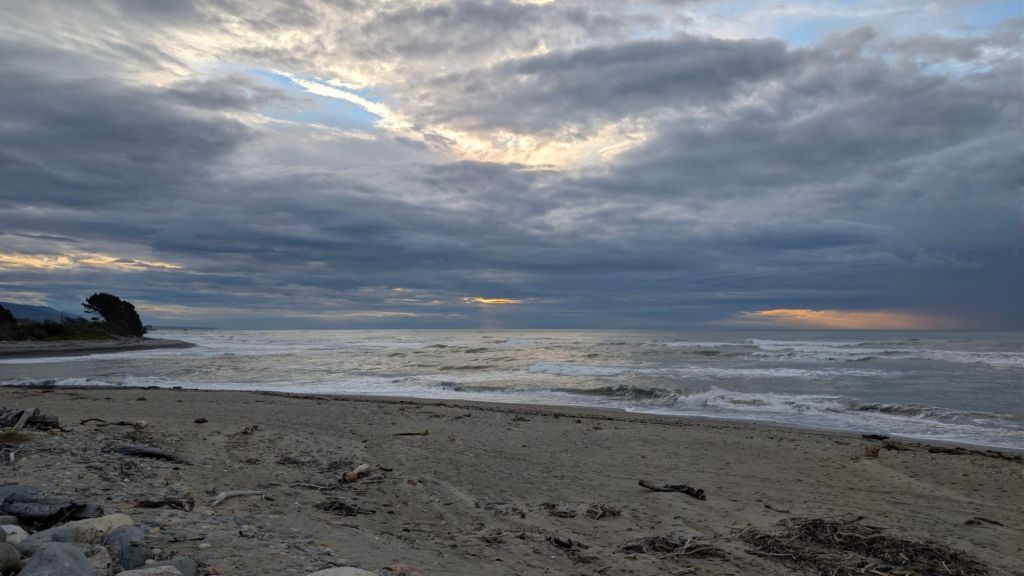
It was a great spot to hang out because just a stone’s throw away from my little perch was a designated freedom camping parking lot where I stayed the night.
So cool to be able to be here and enjoy these beautiful wonders of nature. 🤍
Lift the world.
Bring it on.
~ stephen
 Lift the World